
Methods in project management. critical path
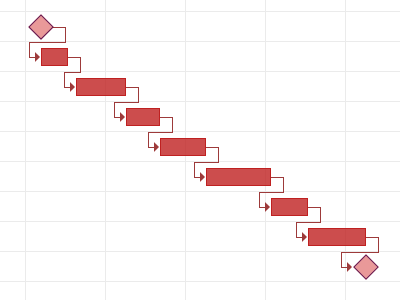
Project management is what keeps the building on track and keeps the building process running smoothly. Project managers manage not only the technical part of the construction, they work closely with workers, company managers and the public.
Traditional project management includes checkpoints between tasks, this method defines clear deadlines for tasks, displays on the timeline the sequence of works that form the final goal set by the customer.
Waterfall principle, or traditional project management, works like a real waterfall - the workflow, like water, flows down to the goal – completion of the assigned task. Each phase or task must be completed so that work can continue and flow like water in the intended direction.
For example, it is necessary to agree on all technical issues of future construction before the start of the construction phase itself. The peculiarity of such planning is that each phase must be completed before the start of the next phase of work.
One of the advantages of this method is the focus of the team on each individual stage, which allows you to qualitatively implement stage by stage.
The downside is that the builders will wait for the end of one stage before starting the next. Delays at one stage, respectively, will affect the entire construction and lead to an increase in the deadline for the completion of the facility.
The Critical Path Method is a tool used by many project managers and often used in construction management software solutions.
This method allows you to find out what measures need to be taken to work effectively and is one of the most commonly used construction planning methods.
While the critical path only considers task dependencies, the critical chain focuses on the longest task chain, taking dependent tasks and resources into account. This means that the tasks and resources of the project are ordered and scheduled.
If there is a task dependency, then the successor task can only run after the predecessor task has completed, however this assumes that the required resources are available.
Unfortunately, problems during construction can also arise with this method, due to the inefficient allocation of resources during planning and the lack of reliable information in the process of project implementation. The critical chain, in this case, helps to recognize the impact of changes on the project implementation process by providing metrics, progress reports and information for action, determining exactly where actions should be taken.
The critical chain, unlike the critical path, does not change during the course of the project. Decisions and actions taken to protect the critical chain will always remain in effect.
Using the available information effectively and assessing the changes that affect the delay is the key to delivering the project on time and on budget.
The critical chain methodology requires more disciplined thinking when planning and executing your projects. It consists of two parts: the first technical – it is the recognition of the importance of resource dependencies in project planning; second – it is the willingness to challenge your current paradigms by developing a new way of thinking.
This methodology is a challenge to some long held beliefs about what practices lead to successful project management. If you want improvement, then you must change. Otherwise, the results you see now will not improve in the future.
Planner Office, using modern cloud technologies, is a convenient and cost-effective tool that is ready to work immediately after launch, and information on the status of all projects in the portfolio is designed to meet the needs of all levels of management.
Planner Office, as cloud service, allows you to scale projects using collaboration with colleagues in the mode real time, not limited to the office. Real-time information, advanced risk management capabilities, extensive performance metrics are some of the many tools available for different levels of management.
Planner Office will satisfy the project management requirements of both project managers and company executives.